Pavankumar Tallapragada’s lab studies and designs systems with multiple decision-makers – humans, algorithms, and machines

A fundamental problem in many engineering systems is decision-making. Some examples include controlling temperature in a room, planning and controlling the motion of a robot, and automatic traffic signalling. In many such problems, there is a single or centralised decision maker. On the other hand, Multi Agent Systems are those in which there are multiple agents or decision makers. These agents could be part of a team – like a fleet of robots – or more generally, each agent could be self-interested multiple agents could perhaps even have competing interests.
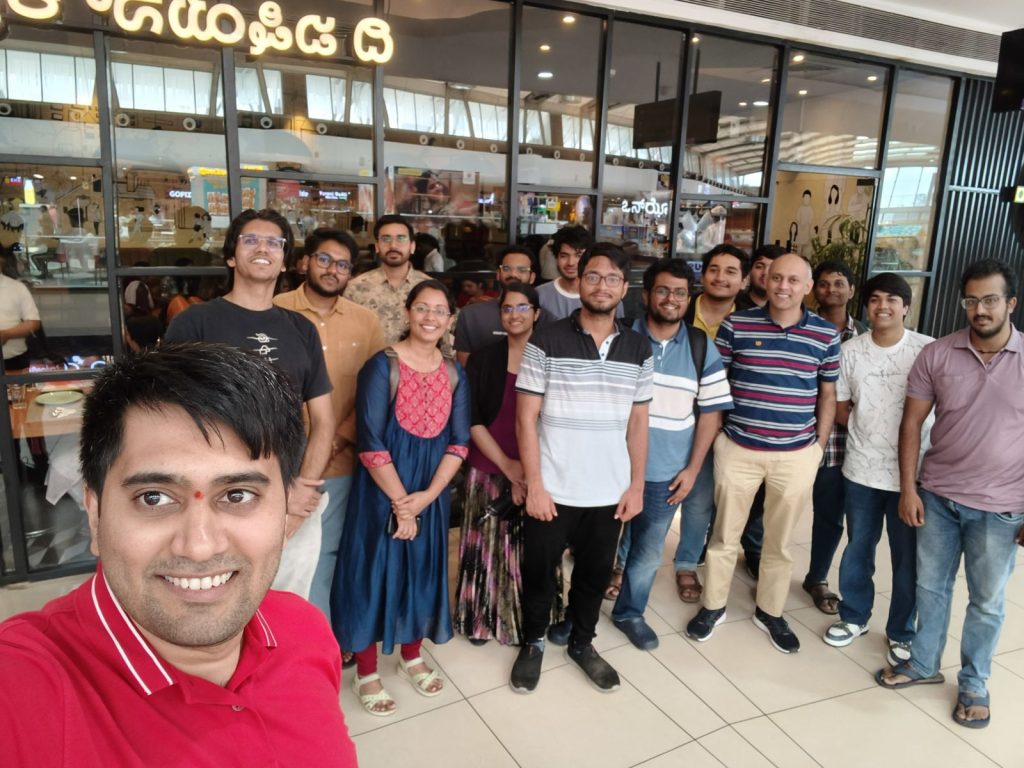
Pavankumar Tallapragada leads the Multi Agent Systems (MAS) lab at IISc, which studies how multiple decision-making agents (robots, AI programs, or human agents) interact in a shared environment, make choices, and coordinate (or are made to coordinate) with one another.
“An analogy to understand multi agent systems and control is to think of a football team, which consists of 11 players, each making independent decisions in real time,” explains Pavan, Associate Professor in the Robert Bosch Centre for Cyber-Physical Systems (RBCCPS). “The performance of the team depends not only on individual skills but also on coordination – through prior planning or through anticipation of teammates’ actions while responding to the opposing team.”
Our own personal lives involve decision making on a daily basis. Some decisions are small – like what to eat on a given day or choosing which phone to buy – while others shape our entire lives – such as choosing a career path. Although these choices may often feel personal, they are rarely made in isolation. The actions, opinions, and influences of social circles play a significant role in shaping them. This interplay of individual choices and preferences and collective behaviour is crucial in understanding decision-making and control at an individual level in many engineering systems, and even at the scale of organisations and governments that make decisions balancing various personal and collective interests.
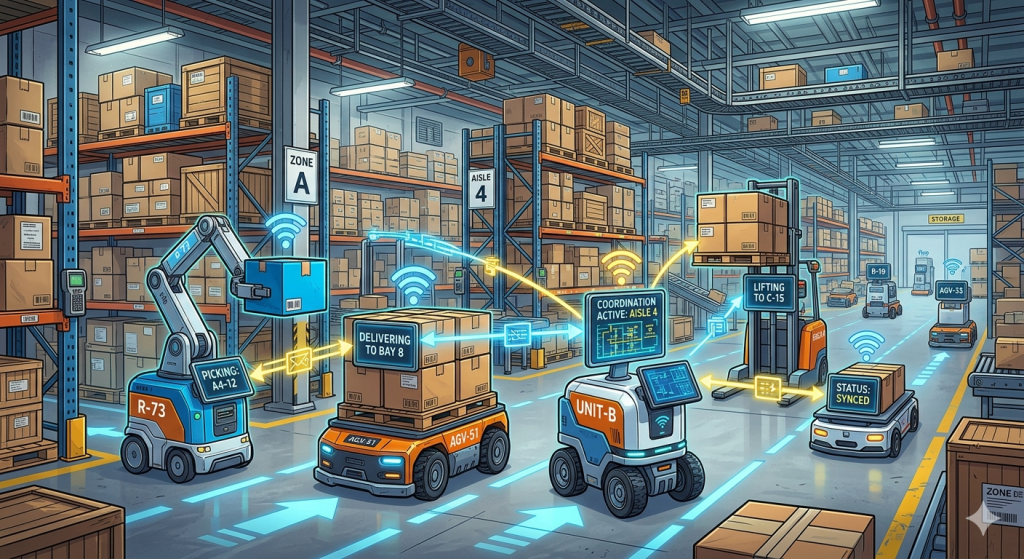
At IISc, some of the major themes that Pavan’s lab focuses on is developing algorithms for control of networked systems under resource constraints such as limited communication resources, multi-robot traffic management, and other large-scale multi agent decision-making problems. His research aims to make complex systems, such as robot fleets, more coordinated and reliable. A major application of such fleets is traffic management in warehouses. “In a warehouse filled with hundreds or thousands of autonomous robots, each robot must decide when to move, where to go, and how to avoid collisions – all the while optimising a shared objective. Achieving such coordination is far from being trivial. As the number of robots increases, the computational demand explodes,” he explains. The MAS lab addresses this challenge by developing scalable algorithms using reinforcement learning models. These algorithms guide agents such as robots to learn from trial-and-error interactions with their environment.
The applications of his work also extend to the routing of taxis. Reinforcement learning models can be used to coordinate tens of thousands of taxis operated by a single company across a city, ensuring that vehicles are distributed based on customer demand. The scalability of an algorithm is also affected by the resources (such as computation or communication) that are required by that algorithm. The MAS lab has, over the years, made fundamental contributions to the development of highly resource-efficient event-triggered control algorithms that are based on the idea of controlling the system of interest only when it is necessary.
The lab also studies problems in which different agents may have different, possibly competing interests. In such cases, they draw ideas from game theory to model how agents anticipate each other’s actions and make strategic decisions. However, in reality, the agents often do not have enough information or the computational resources required to make strategic decisions.
Pavan gives the example of a person wanting to buy a used vehicle. Most people do not have the information to objectively evaluate the value that a particular used vehicle might give them. Even if they did, they might not have the time or other resources to do the evaluation themselves. Hence, in such situations, people heavily rely on social signals and opinions to make decisions. Given this observation, the MAS lab studies the interplay of game theory, social networks, and opinion dynamics in social networks, particularly in the context of constrained resources (such as time, money or influence) allocation.
Complex multi agent systems can also be used for harmful or detrimental applications. In war or combat, for example, robots and drones developed for day-to-day applications can also be weaponised. “The same technology can easily be used for both good and bad,” Pavan elaborates. He points out that the weaponisation of science and technology could also be a lot subtler in our connected, information-rich world. For example, advertising and marketing are methods for social manipulation, albeit for relatively benign purposes. But similar methods could also be used for malicious social manipulation by corporations, governments or other entities. For years, search engines have already been tailoring search results based on users’ history, he explains. With emerging AI tools like Large Language Models (LLMs) this could very easily go a step further by generating personalised news articles that align with an individual’s interests or biases, he explains. In such a scenario, people could easily end up in an information bubble and make themselves susceptible to social manipulation.
To counter such risks, Pavan explains that it is very important to study and design – to the extent possible – social systems that are more resilient to such malicious manipulations, and to maintain their integrity. Such work would have applications in a wide range of domains such as public health, finance, and urban planning.
What Pavan enjoys the most about his work is interacting with his students. He emphasises the importance of fostering scientific thinking among students. In his view, while papers and other project outcomes are important, the most important goal is to develop a scientific outlook, in a way that extends beyond the narrow domain that a student might develop expertise and publish papers in.
Apart from research, Pavan also enjoys sports and walking. “Since I stay on campus, I frequently take walks to enjoy the natural beauty of IISc,” he says. “When I travel for conferences, I prefer walking through cities rather than taking taxis because it gives me a better sense of how the city is organised and how people live there.”