(Image: Neethu C)
Aerosols – suspensions of liquid or solid particles in the air – cause air pollution and affect the planet’s climate and water cycles. Reflective aerosols such as sulphates reflect solar radiation back to space and cool the climate, while absorbing aerosols such as Black Carbon heat up climate systems. Experts have long believed that heavy aerosol loading in South Asia could be disrupting the regional water cycle and summer monsoon rainfall over India.
A crucial question that has not been sufficiently investigated is: How much aerosol over South Asia is too much? What aerosol burden in the atmosphere could cause a reduction of about 10% or more in monsoon rainfall, which leads to a drought year, as defined by the Indian Meteorological Department? In the last 15 years, scientists have strived to set upper limits to regional aerosol burdens, but a rigorous model-based confirmation of these boundary values has been lacking.
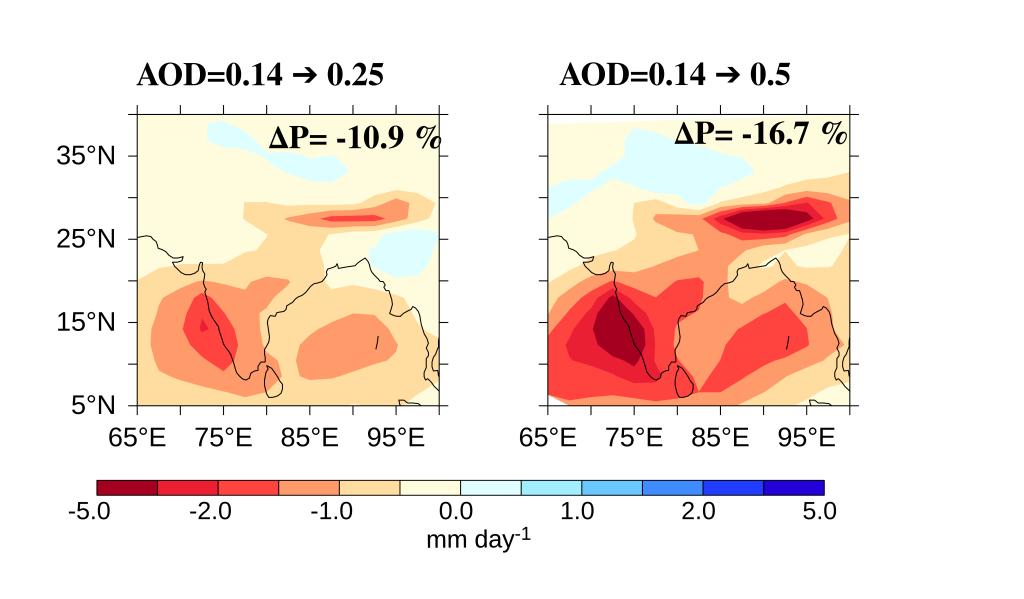
A new climate modelling study from Govindasamy Bala’s group at the Centre for Atmospheric and Oceanic Sciences (CAOS), IISc, fills this void. It finds that when the regional mean aerosol loading over South Asia increases by a factor of 2.7 from today’s levels, it could lead to a 10% reduction in summer mean monsoon rainfall over India. An increase by a factor of 5.5 could lead to about 20% reduction. The aerosol optical depth (AOD) – a scientific measure of sunlight extinction by aerosols – increases from an annual mean value of 0.14 to 0.25 and 0.5, respectively, in these two scenarios. These increases in regional loading also correspond to an increase in emission rates over South Asia by a factor of 4 and 9, respectively. The current proposed limit for regional AOD in South Asia is 0.25 – the new study confirms this value.
The study shows that an increase in aerosol loading by a factor of 2.7 could lead to major and persistent droughts in India. This reduction in rainfall is irrespective of whether the aerosols are reflective or absorbing, although the magnitude of reduction would depend on the type. Further, the absolute aerosol loading over South Asia is the key determinant of reduction in summer monsoon precipitation, as long as aerosol emissions outside South Asia are not drastically increased.
Future high emission climate scenarios lacking stringent air quality control project large regional emissions over South Asia where the mean AOD could reach values as high as 0.69 in 2050. This can potentially lead to a 30% reduction in mean summer monsoon rainfall. Therefore, to ensure the water security and health of the nearly two billion people in the South Asian region, there is a critical need to drastically reduce these aerosol emissions.