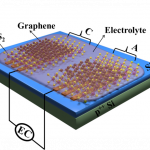
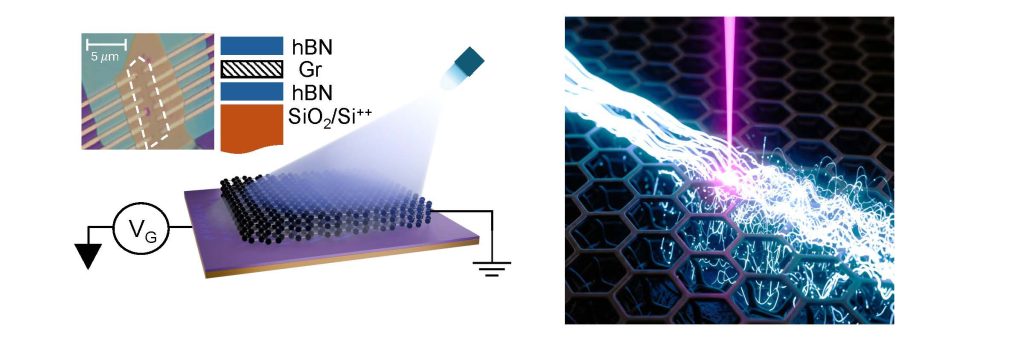
A team of researchers at IISc and NIMS, Japan, has recently developed a technique that enables them to tune the defect density in ultraclean hexagonal boron-nitride-encapsulated graphene devices, thereby controlling the flow of electrons in such devices. This work highlights a pathway to dynamically switch between fluid-like and disorder-dominated transport within the same device.
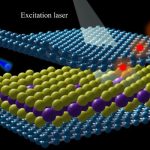
They demonstrated that the flow of electrons near room temperature can resemble a viscous liquid – a hallmark of electron hydrodynamics – and can be reversibly and controllably tuned using ultraviolet (UV) illumination, combined with an applied back gate electric field. UV light activates transient charge-trap states within the dielectric layers and interfaces, allowing them to modulate momentum-relaxing scattering rate in the graphene without permanently degrading the channel.
To understand this phenomenon, the team used electrical transport techniques in conjunction with Johnson-Nyquist thermometry, a highly sensitive noise measurement technique used to determine electronic temperature and thermal conductivity. It is reported that devices violate the Wiedemann-Franz (WF) law in their pristine condition at room temperature and approach the recovery of the WF law when subjected to UV irradiation as back gate voltages are applied progressively.