How different animals forage in urban spaces
In Aesop’s fable, the country mouse lives a simple but safe life, while the city mouse enjoys lavish meals shadowed by constant danger. In today’s cities, this old story is more fact than fiction. Across pavements, drains, streetlights, landfills, and balconies, animals that have traded the familiarity of the wild for the abundance of the city have to make daily decisions about where and how to find food.
In urban landscapes, humans have created endless food options – most just a click of a button away. Cities can hence become extraordinarily resource-rich for animals: leftovers and deliberate feeding, among many other factors, offer them a plethora of options – provided they can adjust well to exploit these.
Ecologists usually study the feeding habits of animals through the lens of the “optimal foraging theory,” which states that animals use strategies that involve spending minimum energy for maximum returns. Such behaviours have likely evolved over generations spent in relatively stable environments in the wild, allowing the animal to develop an intimate knowledge of its surroundings. But in cities, which are constantly changing, this theory doesn’t hold.
Foraging in cities, therefore, is mainly a problem of navigation and decision-making. Animals must learn where food appears, when it is reliable, how risky it is to obtain, and which foods meet their nutritional needs. Both wild and urban animals need to use learning, memory, and social cues to make trade-offs between food and risk, but the latter need to adapt to these skills much faster in more uncertain environments.
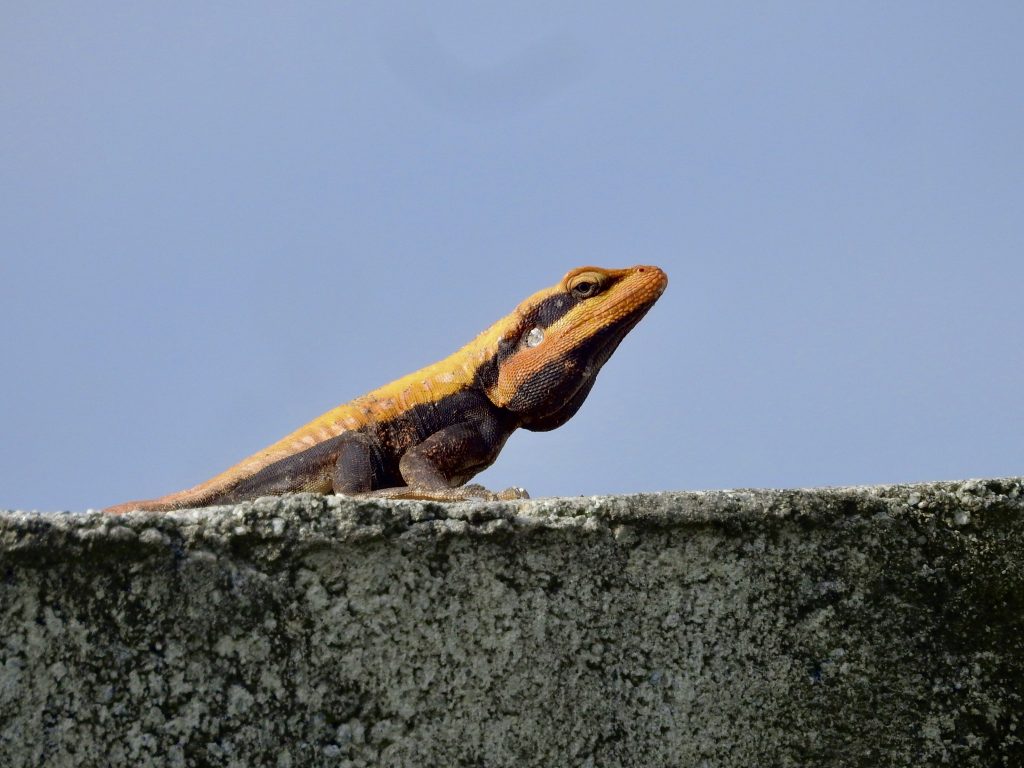
A classic example is the Indian rock agamid, Psammophilus dorsalis. Over the past decade, Maria Thaker, Professor at the Centre for Ecological Sciences (CES), IISc, and her team have been documenting these lizards’ urbanised lives. Earlier, the animals lived on rocky boulders in the wild, feeding on a wide platter of insects in the surrounding vegetation; they have now adapted to living in little green pockets of suburban Bengaluru. But even with smaller living spaces and little diversity of insects, however, starvation seems to be the least of their concerns. “When we looked at their stomach contents, they’re fuller in the city … They’re eating really well and are full of ants and other insects,” Maria notes.
While this ant-heavy diet may seem impoverished, nutritional analyses tell a different story. “Their diet enables them to consume the same carbon–nitrogen ratio no matter where they were,” Maria explains. Lizards actively regulate their intake, converging on an optimal protein-to-carbohydrate balance shaped by evolutionary history. Luckily, the lizard’s taste for ants has allowed it to feast comfortably in cities where ants are the most abundant.
However, changes in the lizards’ physiology reveal the risks they face in the city. Really stressed animals have a higher demand for carbohydrates. While urban and rural lizards seem to be consuming the same amount of carbohydrates, urban lizards’ retention of this macronutrient is higher. Maria’s team had also established that urban lizards are smarter when it comes to finding hiding places to steer clear of predators – an adaptation resulting from facing greater risks.
Lights and sounds
Cities can also change the way animals forage. Loud noises from traffic, for example, can be a challenge for predators like owls and bats hunting for food using audio cues. But artificial light at night (ALAN) could also provide novel sources of food by attracting swarms of flying insects. Streetlights within the IISc campus, for example, attract swarms of flying insects, inviting birds like the oriental magpie-robin (Copsychus saularis) to forage as early as 2.30 am. “[These birds can hence] raise more chicks and sometimes more broods too every year,” explains Ravi Jambhekar, an urban ecologist and Assistant Professor at the Indian Institute of Human Settlements.
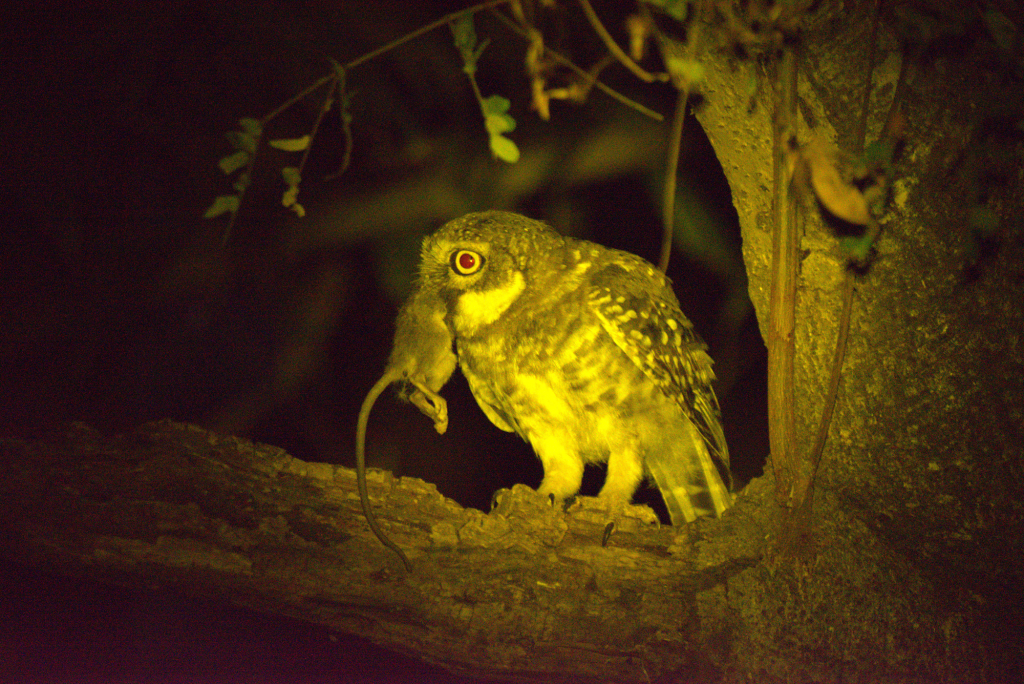
Yuyutshu Bhattacharya and Pratik Das, PhD students in Rohini Balakrishnan’s lab at CES, aim to better understand the effects of anthropogenic factors on such creatures. They have, for example, found that a species of urban tolerant owl – the spotted owlet (Athene brahma) appears to shift from sound-based to visually-guided hunting under streetlights. “They do forage in lit areas, but the prey items are predominantly insects,” Yuyutshu explains. Insects are protein-rich but require frequent intake to meet the birds’ nutritional demands, while rodents – caught in darker patches using audio cues – offer higher energy returns. Yuyutshu is trying to figure out which strategy the owlet uses and when.
For bats, too, urban foraging is shaped both by sound and light. Pratik studies echolocating bat assemblages across urban and rural landscapes, and how they are organised by prey availability, habitat structure, and sensory constraints. “Of all the bats known in the world, about 87% echolocate,” he notes.
Streetlights attract insects, benefiting fast-flying bats that swoop on their prey mid-air (aerial hawkers), while slower bats that pick their prey off surfaces by detecting their sound cues (surface gleaners) tend to avoid lit areas to avoid risk of predation. Noise adds another layer: although traffic sound does not usually overlap with ultrasonic echolocation, it can mask the sounds of prey for surface gleaners. Bats relying on active sonar for navigation may also need to adjust their calls. “[They] can shift their echolocation frequency slightly … and may increase their call intensity,” Pratik adds.
Meat and manipulation
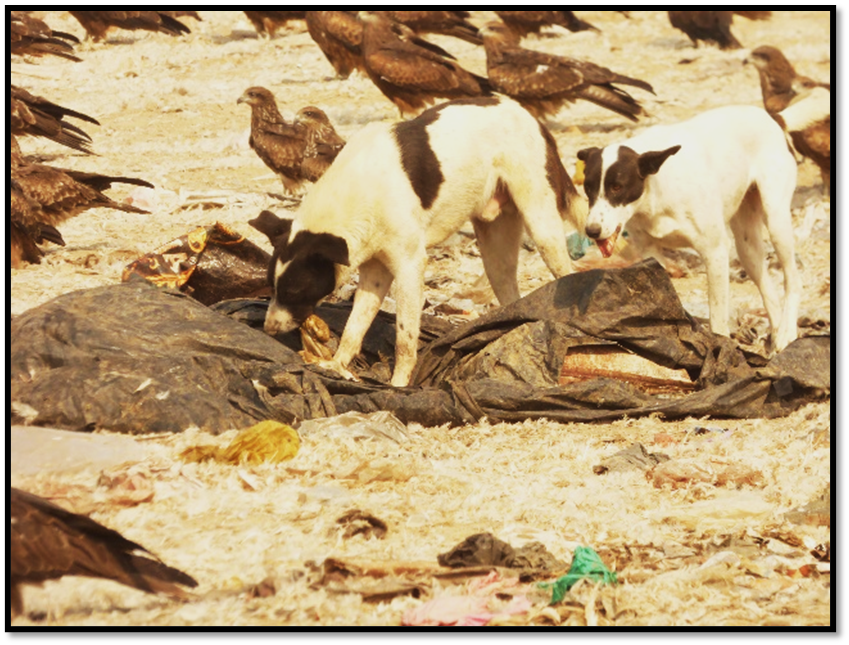
Free-ranging dogs perfectly illustrate what it means to be truly urban-adapted. Within the urban scavenging network, dogs sit firmly at the top, with birds such as common mynas succeeding only in their absence. They have successfully shifted their ancestral hunting habits to becoming “excellent” urban scavengers, notes Anindita Bhadra, Professor at IISER Kolkata.
“They will preferentially go and find meat-based food, and if not, they will switch to anything else that’s available, which is carbs of all kinds,” Anindita explains. What’s more amazing is how they have developed a subtle understanding of human behaviour and used it to their advantage. “They are excellent at begging and manipulating humans. The fact that they tend to beg more in front of women is possibly due to women having a higher propensity to give food,” she says.
Dogs seem to tweak their behaviour based on risk. During Durga Puja in Kolkata, surveys showed that dog numbers at feeding sites dropped even as food availability increased. “The dogs that were sighted were showing much higher levels of vigilant behaviour,” Anindita recalls. Individuals arriving from distant territories would “come, grab food, and run away,” while local dogs remained and fed more calmly.
Dogs also display striking problem-solving skills: when presented with chicken treated with lemon – an odour they dislike – they do not abandon the food. Instead, they “sniff, take the piece where there is the least lemon smell,” and use different strategies to access it, Anindita says.
Yet their urban success has limits. Dogs do not naturally form large groups, and unusually high local densities caused by aggregation at reliable feeding sites can disrupt hierarchies, increase aggression, and escalate conflict.
Like dogs, opportunistic creatures such as black kites (Milvus migrans) also depend on human food waste and deliberate handouts, which are dispersed variably across cities. For instance, ritual meat offerings make up to 90% of the breeding (M. m. govinda) kites’ diet in Delhi, according to Nishant Kumar, an India Alliance Fellow at NCBS, Bangalore, who is associated with Thinkpaws Foundation in Delhi. “Kites exploit this by semi-colonial nesting in green areas that have proximity to regular availability of meat,” he says. As a result, kite nest densities range from zero to 200 per square kilometre, depending on where ritually available meat and large trees for nesting co-occur. Importantly, not all kites forage alike. Resident birds avoid ground feeding, while migratory individuals (M. m. lineatus) that fly in from Central Asian steppe grasslands eat comfortably on the ground at landfill sites, likely because they encounter relatively fewer on-ground anthropogenic or predation threats in their breeding sites.
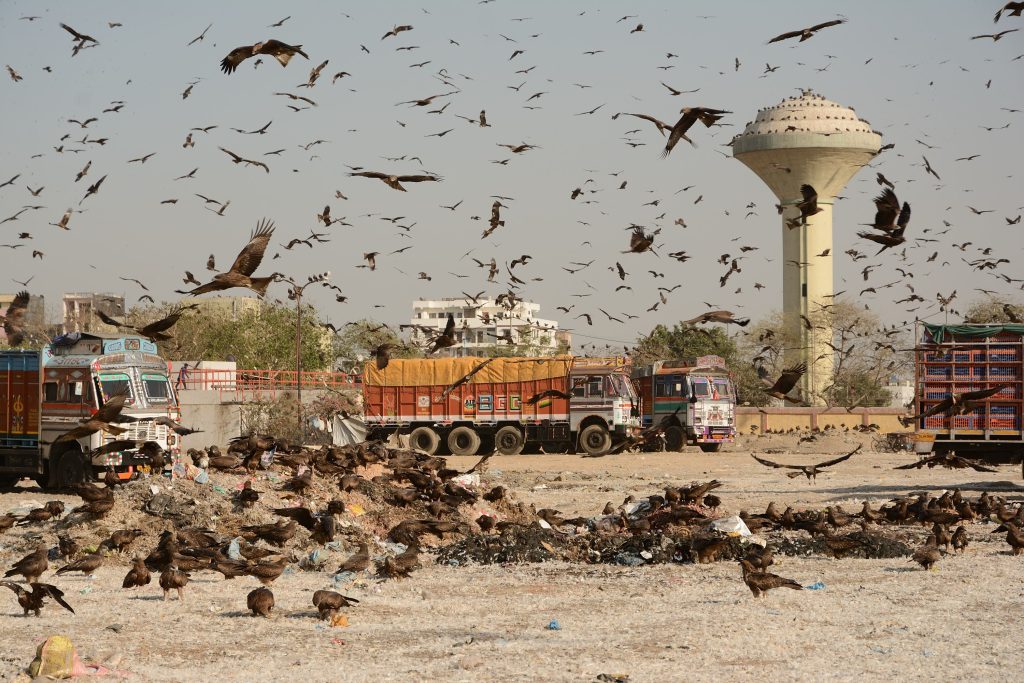
Ultimately, urban foraging is first a cognitive problem. It is influenced by how specific animal populations interpret threats and opportunities associated with human behaviour and environmental cues, Nishant argues. In an ongoing university campus experiment, he and his colleagues found that macaques avoided Pepsi bottles and preferred to process other soft drink bottles from waste because the blue Pepsi bottles unintentionally “mimicked” the prevalent blue wrapped packaged water bottles in the environment. In other parts of the city, where they had not made such associations from watching and learning, macaques showed no colour preference while rummaging through spent PET bottles from waste.
From lizards to macaques, creatures that can interpret risk, adjust behaviour, and learn quickly often benefit from cities’ abundance. Successful urban species tend to be generalists, behaviourally flexible, and tolerant of humans, while specialists often fall behind. As cities continue to expand, understanding how animals forage is central to coexistence.